
Zinc alloy and plastic can both produce successful beauty accessories. The right material is not the one that sounds more premium in isolation; it is the one that supports the product’s function, target price, visual language, shipping plan and expected order scale.
For compact mirrors, decorative combs and gift sets, the material decision affects weight, surface detail, color options, tooling, assembly, packaging protection and inspection. This guide gives overseas buyers a practical comparison and a decision framework they can use before requesting samples or quotations.
Quick comparison
Zinc alloy is commonly selected when a buyer wants a substantial hand feel, detailed decorative form and metal finishing such as electroplating. Plastic is often selected when lower weight, molded color, efficient high-volume production or a lower cost structure is more important. Many products combine materials—for example, a metal decorative shell with internal parts, mirrors, inserts or functional components made from other materials.
Neither category guarantees quality. A well-engineered plastic accessory can outperform a poorly finished metal one. Quality depends on material grade, product design, tooling, process control, assembly and inspection.

What is zinc alloy in beauty accessories?
Zinc alloys are metal materials formulated for manufacturing processes such as die casting. They can reproduce fine decorative details and accept several surface-finishing processes. In a compact mirror or decorative comb, zinc alloy may be used for an outer shell, frame, handle, decorative plate, charm or other visible component.
Buyers should not assume an exact alloy composition from the phrase “zinc alloy.” The supplier should confirm the material used for the specific item when that information is relevant to buyer requirements or testing. Likewise, a plated surface is a finish system applied to a substrate; the visible color does not identify the base material by itself.
Typical reasons buyers consider zinc alloy
- Substantial, gift-like hand feel
- Ability to reproduce relief and ornamental detail
- Compatibility with metallic decorative finishes
- Perception of permanence for collectible or premium sets
- Suitability for small decorative components and charms
Potential trade-offs include higher product weight, more demanding surface inspection and the need for packaging that prevents abrasion or impact damage.
What does “plastic” mean in a sourcing specification?
Plastic is not one material. Different resin families, additives, colors, surface treatments and molding methods produce very different properties. A sourcing brief should identify the proposed material when confirmed and describe the performance needed: rigidity, impact resistance, appearance, surface feel, heat exposure, chemical contact or decoration compatibility.
Plastic components may be molded in color, painted, printed, plated or assembled with decorative parts. For combs, tooth geometry and edge quality are as important as the resin. For mirror cases, hinge design, wall thickness, mirror retention and surface protection must be reviewed.
Typical reasons buyers consider plastic
- Lower finished-product weight
- Molded color across complex forms
- Potential cost efficiency at suitable volume
- Broader freedom for large shapes without excessive weight
- Suitability for everyday, travel or promotional positioning
Trade-offs may include tooling economics, visible flow or molding marks, surface scratching and a hand feel that varies widely with design and finish.
Appearance and brand positioning
Material communicates before the customer uses the product. A heavier plated compact can feel like jewelry; a lightweight molded compact may feel playful, portable and accessible. Neither message is universally better.
For a luxury-inspired gift set, zinc alloy can support fine relief, stones, charms and reflective finishes. The packaging must reinforce the same position. A substantial product placed in a thin or poorly fitted box creates a mismatch and may increase damage risk.
For a youth, travel or promotional collection, plastic can support bright molded colors and larger graphic forms while keeping weight manageable. Premium plastic design relies on thoughtful geometry, controlled surfaces and consistent assembly—not merely a glossy coating.
Ask these brand questions:
- Should the item feel collectible or everyday?
- Is handbag portability important?
- Will the product be sold alone or in a gift box?
- Does the brand language rely on metallic ornament, soft color or graphic printing?
- Is the expected retail life seasonal or long term?
The answers narrow the material options before cost is discussed.
Weight, shipping and customer experience
Weight influences perceived value, international freight, carton design, fulfillment cost and user comfort. A difference that feels small per unit can become significant across thousands of sets.
Request net product weight and packed-set gross weight from the approved sample. Estimate freight using packed dimensions and carton data, not product weight alone. For air or express shipments, dimensional weight may control cost. For ocean freight, carton efficiency and total volume remain important.
During application testing, consider how the user holds the mirror and comb. A decorative hand mirror may benefit from a balanced, substantial feel, while an everyday compact should not become inconvenient in a handbag. A comb handle should feel controlled without making the wrist work unnecessarily.
Do not reduce material thickness solely to lower cost or weight without engineering review. Thin walls, weak attachment points or poorly balanced structures can create quality problems that exceed the savings.
Detail, tooling and design freedom
Zinc-alloy die casting can capture ornamental relief and small decorative forms. Tooling design must account for draft, wall thickness, parting lines, ejection and finishing access. Extremely fine digital artwork may still need simplification.
Plastic injection molding supports complex forms and efficient replication, but the design must account for material flow, shrinkage, ribs, bosses, gates and visible surfaces. A rendering that ignores these factors may require substantial modification before tooling.
In both cases, ask for production-oriented drawings. Confirm:
- Overall dimensions and critical fit dimensions
- Visible and hidden surfaces
- Parting line and gate expectations where relevant
- Logo or relief depth
- Assembly points
- Areas requiring polishing, plating, paint or printing
- Acceptable visual reference
Tooling ownership should be clarified in the commercial agreement. Record who pays, who stores it, whether it can be used for other customers, expected maintenance responsibility and what happens if the project moves or ends.
Surface finishing and decoration
Zinc-alloy finishes
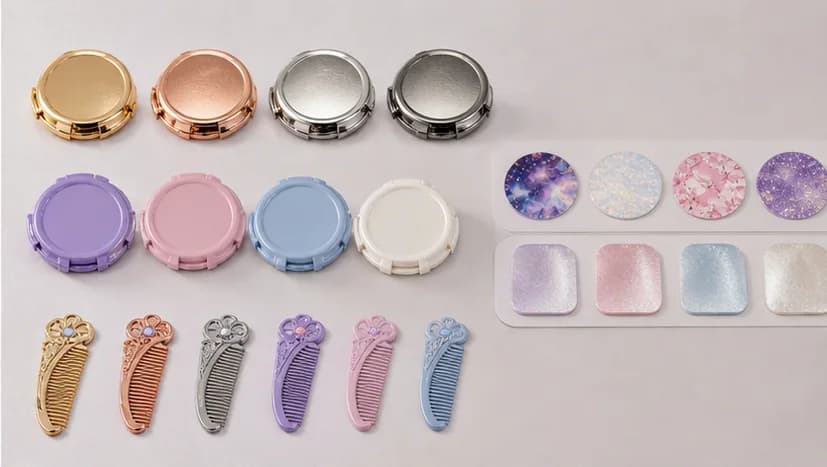
Common decorative approaches may include electroplating, paint, printed graphics, stones, relief details and attached charms. The complete finish system should be approved on the actual product geometry. Recesses, edges and contact points can look different from flat sample chips.
Inspection should consider visible color consistency, coverage, scratches, pits, stains, exposed substrate, printing alignment and decorative-part placement according to agreed standards. High-gloss reflective finishes reveal small surface differences more readily than textured or matte finishes.
Plastic finishes
Plastic can use molded color, paint, printing, vacuum-metalized or plated effects where technically suitable, labels and attached decorations. Molded color can reduce dependence on a separate coating, but color consistency still requires material and process control.
Paint or metallic effects can expand appearance but add process steps. Verify adhesion and abrasion expectations for the intended use. Decorations near hinges, edges and high-touch areas need particular review.
Durability: ask about the failure mode, not “which is stronger?”
“Strength” is too broad for material selection. A product can fail by impact, bending, hinge fatigue, coating wear, stone loss, mirror breakage, comb-tooth damage or packaging abrasion. Zinc alloy and plastic respond differently to each condition, and product geometry often matters more than the material label.
Define realistic use and transport scenarios:
- Repeated opening and closing
- Handbag contact and surface abrasion
- Representative drop or impact in final packaging
- Temperature and humidity exposure during storage or transit
- Cleaning or cosmetic contact expected in normal use
- Load on comb teeth or decorative handles
Factory testing should use agreed methods and record the sample condition before and after. Avoid claims such as “unbreakable” or “scratch-proof.” A credible supplier describes the test method, result and limitation.
Packaging requirements by material
Zinc-alloy products are heavier and may need stronger inserts and better separation between components. If a metal comb can contact a plated mirror during transport, both surfaces may be damaged even when the outer box remains intact.
Plastic products may be lighter but can still scratch or deform if the insert grips incorrectly. Painted surfaces need protection from rubbing. Clear protective films can help in some applications, but they affect labor, appearance and the customer’s unboxing process.
Packaging development should use the final or representative product weight. During shipment preparation, verify:
- Product restraint in all directions
- Separation of hard surfaces
- Finger access without forced bending
- Lid and insert stability
- Master-carton stacking and internal protection
- Carton weight suitable for handling requirements
Run representative handling or transport tests on the packed set, not only on individual products.
Cost structure and total landed cost
Unit price is only one part of material economics. Compare:
- Tooling and development
- Base part production
- Finishing and decoration
- Assembly and inspection
- Protective packaging
- Freight and fulfillment
- Expected defect, rework and replacement risk
- Inventory commitment by SKU
Zinc alloy may have a higher product and freight cost but support a higher-value gift position. Plastic may lower weight and part cost at suitable scale but require tooling and finish investment. The better commercial choice is the one that achieves the required margin and customer experience after all costs are included.
Ask for alternative quotations based on controlled changes. For example:
- Zinc-alloy outer shell versus molded plastic shell
- Shared internal platform with different decorative covers
- Plated finish versus molded color plus printing
- Metal charm versus printed or molded motif
Do not compare quotations that silently change dimensions, mirror configuration, packaging or inspection scope.
Sustainability and responsible claims
Material sustainability cannot be reduced to “metal good” or “plastic bad.” Consider product longevity, material quantity, recycled-content evidence where claimed, finish systems, packaging, transport weight, repairability and end-of-life separation.
Avoid environmental claims without documentation and market-specific review. Terms such as recyclable, recycled, eco-friendly and sustainable may require evidence and precise qualification. Ask suppliers for available material documentation, but the brand or importer remains responsible for the claims placed on consumer packaging.
A practical first step is design efficiency: avoid unnecessary material, reduce oversized packaging, create durable products and minimize SKU obsolescence. These decisions can be evaluated even when full lifecycle data is unavailable.

Quality control and shipment inspection
The inspection checklist should reflect the selected material and finish.
Zinc-alloy accessory checks
- Casting and visible surface condition
- Finish coverage and color consistency
- Scratches, pits or exposed areas
- Product weight and dimensions
- Attachment and hinge function
- Decorative component security
- Packaging separation and abrasion protection
Plastic accessory checks
- Molding condition and deformation
- Visible flow, sink or gate appearance against the agreed standard
- Color consistency
- Edge and comb-tooth finish
- Assembly and hinge function
- Paint or print condition
- Packaging pressure and scratch protection
Shipment inspection should use the approved sample and current specification. If several colors or finishes are ordered, sample across SKUs rather than checking only the easiest version.
Document findings with clear photos and quantities. When a visual difference is acceptable, update the standard for future repeat orders instead of relying on memory.

A buyer’s decision matrix
Choose zinc alloy when the project prioritizes:
- Substantial, jewelry-like feel
- Ornamental relief and small decorative details
- Metallic plating and collectible presentation
- Premium gifting where weight supports perceived value
Choose plastic when the project prioritizes:
- Lower weight and portability
- Bright molded color or larger forms
- Cost efficiency at an appropriate production scale
- Everyday, travel or promotional positioning
Consider a hybrid construction when:
- A metal exterior is important but total weight must be controlled
- The buyer wants a stable internal platform with interchangeable covers
- Different functions require different material properties
- A decorative metal badge or charm can create value without making the full structure metal
Always validate the actual sample. A decision matrix narrows options; it does not replace testing.
Application scenarios
Premium seasonal gift set
A zinc-alloy compact with a plated decorative shell, coordinated comb and rigid box may support a premium seasonal story. Focus factory testing on finish, hinge, attachments and packed transport protection.
High-volume promotional program
A plastic compact and comb with molded brand colors and efficient printed packaging may better control weight and budget. Focus on molding consistency, artwork alignment, packaging efficiency and schedule.
Travel-oriented retail set
Weight, compact dimensions, secure closure and scratch protection matter. A hybrid or well-designed plastic platform may be practical, while selective metal details retain a premium cue.
Collectible brand extension
A distinctive metal decorative plate or charm can connect the tool to a larger beauty collection. Confirm tooling, finish reference and repeat-order consistency before launch.
FAQ
Is zinc alloy always more premium than plastic?
No. Material contributes to perception, but design, finish, assembly, packaging and brand context determine the final experience. Poor metal finishing can feel less premium than high-quality plastic execution.
Is plastic better for low MOQ?
Not automatically. Existing stock plastic platforms may support efficient customization, but a new injection mold can require substantial tooling and production volume. Ask about the exact product route.
Which material is better for electroplating?
Zinc alloy is commonly used for plated decorative accessories, while some plastic processes can also create metallic effects. The supplier should confirm the substrate, process and expected performance for the specific design.
Which material is lighter for international shipping?
Plastic is generally lighter for comparable forms, but actual weight depends on design, wall thickness, components and packaging. Compare approved packed samples and carton data.
Can a zinc-alloy comb be used every day?
It depends on tooth geometry, edge finishing, balance and intended use. Review a functional sample rather than judging from material alone. Decorative combs and everyday detangling combs may require different designs.
What should be tested before mass production?
Confirm dimensions, function, mirror retention, comb edges, finish, logo, decorative attachments, insert fit and packed protection. Add buyer- or market-specific tests where required and qualified.
Can I combine zinc alloy and plastic in one gift set?
Yes. Hybrid designs are common because different materials can serve different functional and aesthetic roles. Confirm color matching, interface fit and how materials behave during assembly and transport.
Conclusion
Zinc alloy and plastic are design tools, not quality rankings. Zinc alloy can deliver decorative detail, metallic finish and substantial feel. Plastic can deliver lower weight, molded color and scalable form. A hybrid design can balance both.
The most reliable decision process begins with the customer and use case, then compares sample appearance, function, total landed cost, packaging and inspection risk. Document the chosen material and finish in the specification, approve a representative sample and inspect bulk production against that reference.