
A custom mirror and comb gift set looks simple when it is displayed on a retail shelf. From a sourcing perspective, however, it is a coordinated system: two functional products, several decorative processes, a fitted insert, printed packaging, brand artwork and an inspection standard must all work together. The best results come from treating the set as one product program rather than purchasing a mirror, a comb and a box separately.
This guide explains the decisions an importer, beauty brand, gifting buyer or distributor should make before requesting a quotation. It also shows where projects commonly lose time, which details belong in a sample approval, and how to prepare a specification that a manufacturer can actually produce.
Quick answer: what does customization normally include?
For a mirror and comb gift set, customization may include product shape, color, metal finish, printed artwork, relief details, stones or charms, logo placement, mirror configuration, comb style, packaging structure, insert material and outer-carton marking. Not every project needs every option. A lower-risk program usually begins with an existing product platform and customizes its color, graphics, decoration and packaging. A fully original structure may require new tooling, additional engineering checks and a larger commercial commitment.
Before discussing price, define three things: the target customer, the intended sales channel and the level of differentiation. A promotional set for a seasonal campaign has different priorities from a premium retail gift set expected to remain in a collection for several years.
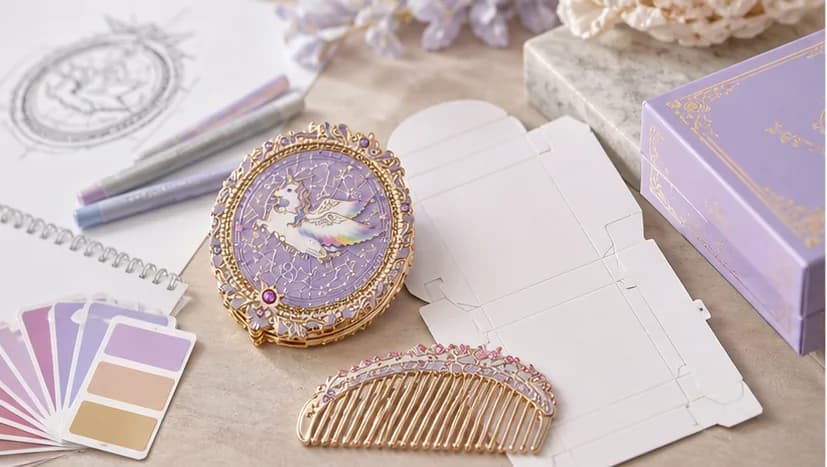
Step 1: write a commercial brief before a design brief
Buyers often begin with a mood board. That is useful, but a supplier also needs the commercial boundaries that turn the mood into a viable product. A practical first brief should state:
- Target market and sales channel
- Intended retail position or target landed-cost range
- Estimated order quantity by design or color
- Required launch or delivery date
- Whether the project uses an existing platform or a new shape
- Required logo, artwork and packaging languages
- Destination country and any buyer-specific testing requirements
The estimated quantity matters because decoration and packaging processes have their own setup requirements. A box printer, metal-finishing line and insert supplier may not share one minimum order quantity. A manufacturer cannot evaluate the real commercial structure from the total project quantity alone; the quantity per SKU, color and artwork version is more useful.
A strong quotation request describes the product, the variation count and the destination—not only the total number of sets.
If the launch date is fixed, work backward from the required warehouse arrival date. Include time for sample revision, production approval, bulk production, shipment inspection, export preparation, transit and customs clearance. Production time is only one part of the calendar.
Step 2: choose a product development route
Existing platform with private-label customization
This route uses an existing mirror and comb construction. The buyer changes elements such as color, logo, printed pattern, charm combination and packaging. It is normally the most efficient path when speed, manageable risk and a proven mechanism matter more than exclusive geometry.
The buyer should still test the actual proposed decoration. A finish that works on a flat color chip may behave differently on an embossed surface or around an edge. The sample must represent the intended combination of substrate, coating and artwork.
Semi-custom development
A semi-custom project keeps the main functional construction but changes a visible component—for example, a decorative outer plate, relief pattern, handle profile, charm or insert layout. This creates stronger differentiation without redesigning every mechanical element.
Ask the supplier which part is standard and which part is new. Tooling ownership, replacement responsibility and acceptable dimensional variation should be documented before an order is placed.
Fully custom OEM development
A new shape can support a distinctive long-term collection, but it requires a technical drawing, tooling evaluation, prototype or first article, and more extensive validation. Hinges, mirror retention, comb-tooth geometry, edge treatment and assembly clearances are functional decisions. A visually attractive rendering is not a production specification.
For a first program, a hybrid approach is often sensible: use a stable internal construction and invest design effort in the exterior identity, finish and packaging experience.
Step 3: define the mirror specification
The mirror specification should answer more than “round compact mirror.” Record the overall dimensions, closed thickness, net weight target, frame material, opening method and mirror configuration. If the compact includes two mirrors, state whether one side is a standard reflection and whether the other side is magnifying. Do not assume a magnification level; it must be confirmed by the supplier and shown in the approved specification.
Check these points during sample review:
- The product opens and closes consistently without excessive looseness or stiffness.
- The mirror is retained securely and does not rattle under normal handling.
- The reflected image is acceptably clear for the intended product grade.
- Decorative components do not interfere with opening, closing or cleaning.
- Exposed edges feel smooth during use.
- The logo and artwork remain correctly oriented when the product is held or displayed.
A drop test or transport simulation should be designed around the final packaging, not an unboxed sample. Glass-related breakage risk depends on the complete protective system: product construction, insert support, gift box and shipping carton.
Step 4: define the comb specification
Comb decisions include overall size, tooth spacing, tooth-tip shape, handle or folding construction, substrate and surface decoration. A decorative metal comb and an injection-molded plastic comb create different weight, feel and cost structures. The correct choice depends on the brand position and intended use.
Review the sample by running fingers carefully over the tooth tips and edges, inspecting spacing consistency, and checking whether the comb remains straight after finishing. If the comb is carried in a handbag, the design should avoid sharp decorative projections that can snag fabric. If it is secured in an insert, verify that removal does not bend the teeth or scratch the finish.
For sets with a charm, inspect the connection point and ring closure. A charm is not only decoration; it is a small assembly that may be exposed to repeated movement during transport and use.
Step 5: select materials and surface finishes
Material selection influences weight, tactile impression, tooling, decoration compatibility and packaging protection. Zinc alloy is often selected for small decorative beauty accessories because it can support detailed shapes, electroplated finishes and a substantial hand feel. Plastic can reduce weight and may be suitable for higher-volume or cost-sensitive programs, especially where molded color and efficient repeatability are priorities.
Surface options may include electroplating, pearl paint, UV printing, printed graphics, relief elements, stones and mixed decorative assemblies. Each added process creates another interface to control. For example, printed registration must align with the product shape; stones need consistent placement; and electroplated areas should be reviewed for visible color consistency within the agreed acceptance standard.
Do not approve a finish from screen colors alone. Digital displays, paper proofs, plastic color chips and metal-plated samples all render color differently. Use a physical reference or an agreed color standard where practical, then approve the actual decorated sample.
Step 6: plan branding and artwork correctly
Provide vector logo files whenever possible, together with a brand guide that defines minimum clear space, color references and unacceptable variations. State whether a logo may be simplified for very small applications. Fine lines that look correct on a website can disappear or fill in during small-scale printing, relief or metal application.
Create an artwork placement sheet for every branded location:
- Mirror exterior
- Comb or handle
- Charm or decorative plate
- Gift-box lid
- Insert printing, if any
- Instruction card or brand card
- Shipping mark and carton label
Confirm artwork orientation and dimensions, not only “logo centered.” Centering may be interpreted visually, geometrically or relative to another decorative element. A signed sample or annotated drawing removes ambiguity.
Avoid making compliance or performance claims on packaging until the responsible importer or brand has verified that the wording is suitable for the destination market. The manufacturer can apply approved artwork, but the brand owner should control market-specific claims, warnings and legal copy.
Step 7: engineer the gift-box experience
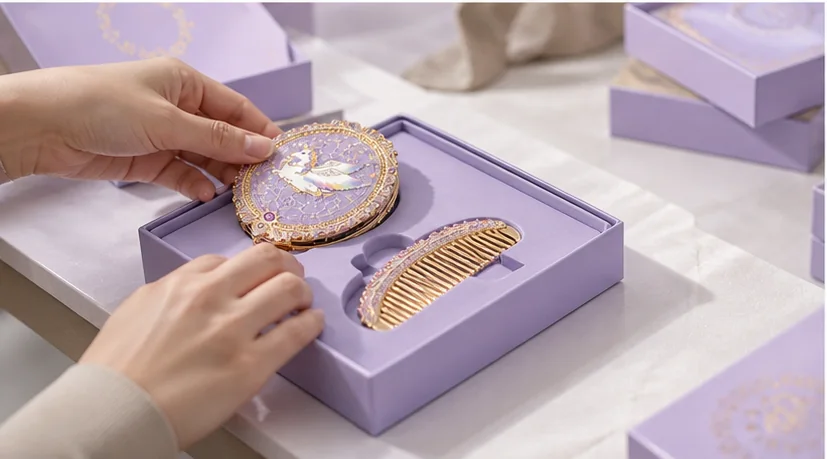
The box has three jobs: protect the products, present the story and move efficiently through distribution. Begin by deciding the unboxing sequence. Should both pieces be visible immediately? Is there a story card? Will the set be displayed closed, open or inside an outer sleeve?
The insert should restrain the products without damaging their surfaces. Test removal with representative users; an insert that holds too tightly may scratch plating or make the product feel difficult to use. An insert that is too loose allows movement, abrasion and noise during shipping.
Packaging decisions should include:
- Rigid box, folding carton or another structure
- Board and wrap-paper appearance
- Printed, foil or embossed decoration
- Insert material and color
- Product orientation and finger-access points
- Barcodes, labels and multilingual copy
- Master-carton quantity and protective packing
Ask for a packaging mock-up before final printed production when structure or artwork is new. A digital rendering cannot reveal lid fit, paper tension, insert grip or how metallic decoration changes under physical light.
Step 8: build a sample approval checklist
Sample approval is a control point, not a general statement that the product “looks good.” Create a written checklist and photograph the approved reference under neutral lighting. Record:
- Confirmed dimensions and weight
- Material and finish description
- Color reference and acceptable visual range
- Logo size, location and orientation
- Artwork version number
- Mirror and hinge function
- Comb edge and tooth condition
- Charm and decorative-part assembly
- Packaging structure and insert fit
- Included cards, labels and accessories
If a sample differs from the intended production method, document the difference. A handmade decorative sample may demonstrate appearance but not production repeatability. Ask what will change in bulk production and whether a pre-production sample using production processes is required.
Step 9: define factory testing and shipment inspection
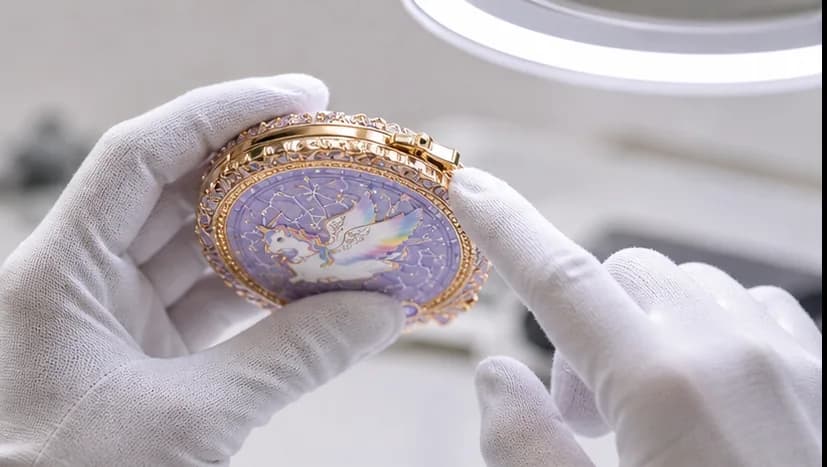
The inspection plan should reflect the risks of the specific set. Typical checks may cover appearance, quantity, dimensions, function, assembly, packaging, labeling and carton condition. The exact sampling method and acceptance level should be agreed between buyer and supplier or inspection provider; it should not be invented after production is complete.
During factory testing, functional checks can include repeated opening and closing, secure mirror retention, comb edge review and basic assembly verification. Packaging checks can include insert fit and representative transport handling. Shipment inspection should compare bulk goods with the approved specification and reference sample, confirm packed quantities and review export cartons before release.
Testing claims must be precise. “Quality checked” is not enough for a buyer to understand what was examined. A useful report identifies the sample size, checks performed, findings, photos and disposition of nonconforming items.
Step 10: prepare for production and delivery
Production should begin only after the commercial order, artwork and product specification are aligned. Keep one controlled version of every file. Late artwork changes can affect printed components already in progress and may create obsolete packaging inventory.
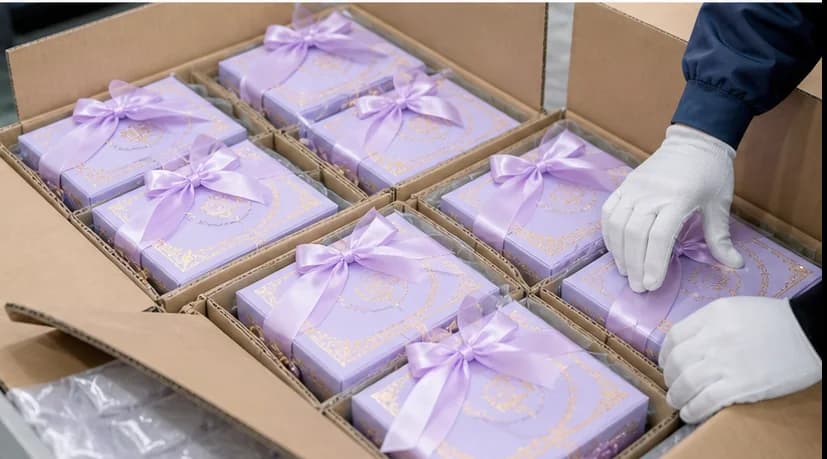
Before shipment, confirm:
- Final packed quantity by SKU
- Carton dimensions and gross weight
- Shipping marks
- Commercial-document information
- Inspection status
- Product and packaging photos
- Planned pickup date and logistics contact
Installation preparation is usually not relevant to a compact mirror and comb set, but retail preparation is. Ask whether products arrive individually labeled, display-ready, protected for fulfillment handling and packed according to the destination warehouse’s requirements.
Common sourcing mistakes—and how to avoid them
Asking for a price before defining variants
One design in four colors is not always equivalent to one high-volume SKU. Each color may require separate setup, artwork, packaging or material ordering. Quote by variant.
Approving only appearance
A beautiful sample can still have a weak insert, inconsistent hinge or impractical comb teeth. Review function, packaging and shipment protection together.
Treating the box as the last step
Late packaging design can change dimensions, insert tooling, carton efficiency and lead time. Start product and packaging development in parallel.
Using unverified claims
Avoid describing materials, certifications, magnification or test performance until they are confirmed for the actual product and order. Accurate, limited claims build more trust than broad promises.
Skipping a controlled specification
Chat messages and separate image files are not a final specification. Consolidate decisions into an approved document with revision control.
FAQ
What information should I send for a first quotation?
Send the product type, preferred platform or reference image, estimated quantity per design, destination market, logo and artwork needs, packaging expectation and target delivery date. If any item is unknown, label it as open for supplier recommendation rather than guessing.
Can I customize only the packaging?
Often, yes. Using an existing product with custom packaging can shorten development and reduce risk. Commercial feasibility still depends on the selected box structure, printing process and quantity.
Do I need a new mold for my logo?
Not necessarily. Printing, UV decoration, a separate badge or other processes may apply a logo without changing the main product mold. A raised, recessed or structural logo may require tooling. The supplier should review the artwork and intended effect.
How many samples should I approve?
There is no universal number. At minimum, the buyer needs a representative approved sample or controlled reference for each materially different construction, finish or artwork version. Additional samples may be useful for internal review, testing and photography.
When should shipment inspection happen?
Inspection timing depends on the plan, but a final random inspection is typically scheduled when production is complete and most goods are packed, while corrective action is still possible before shipment release. Agree timing and criteria in advance.
Can the same set be sold in North America and Europe?
The physical design may be shared, but labels, packaging information, importer responsibilities, testing documentation and market requirements can differ. Confirm requirements with qualified market-specific advisors before final artwork and shipment.
Conclusion
Customizing a mirror and comb gift set is a manageable project when decisions are made in the right order. Begin with the buyer, channel, quantity and deadline. Select a development route. Define the mirror, comb, finish and branding. Engineer packaging at the same time. Approve a documented sample, then inspect production against that reference.
This method protects both creativity and execution. It gives designers room to build a memorable collection while giving procurement teams the information needed to compare quotations, control revisions and prepare a reliable shipment.